


 English
 中文简体
中文简体Don't hesitate to send a message
How to Pick the Right Ebike Hub Motor for Your Needs
Content
- 1 Match Motor Power to Your Terrain and Rider Weight
- 2 Geared Hub Motor or Direct Drive: Choose Based on How You Ride
- 3 Front vs. Rear Hub Motor: Traction and Handling Trade-offs
- 4 Key Specifications to Compare When Shopping
- 5 Voltage System: 36V vs. 48V vs. 52V
- 6 Controller Compatibility: Don't Buy a Motor Without Checking This
- 7 Practical Decision Framework: Matching Motor to Use Case
- 8 Five Mistakes to Avoid When Choosing a Hub Motor
To pick the right ebike hub motor, start with three questions: Where will you ride, how much do you weigh, and what is your budget? For flat urban commuting under 25 km/h, a 250W geared rear hub motor is sufficient. For hilly terrain or cargo loads, step up to a 500W–750W direct drive or geared motor. For off-road or high-speed use, 1000W+ direct drive motors deliver the torque and durability required. Getting these three variables right eliminates 90% of poor motor choices before you look at any other spec.
Match Motor Power to Your Terrain and Rider Weight
Power rating is the single most important specification. Choosing too little means struggling on climbs; choosing too much means wasting battery and potentially violating local road laws.
| Rider + Cargo Weight | Flat Urban | Moderate Hills (5–8%) | Steep Hills (10%+) |
|---|---|---|---|
| Under 80 kg | 250W | 350W–500W | 500W–750W |
| 80–110 kg | 350W–500W | 500W–750W | 750W–1000W |
| 110 kg+ or cargo bike | 500W | 750W–1000W | 1000W–1500W |
A useful rule of thumb: every 10% increase in hill gradient roughly doubles the power required to maintain the same speed. A 90 kg rider cruising at 25 km/h on flat ground needs about 150W of sustained power. On a 10% grade, that same rider needs 500W or more. This is why undersized motors overheat on climbs — they are forced to run at peak output continuously rather than at their efficient mid-range.
Also factor in legal power limits. In the EU and UK, road-legal ebikes are capped at 250W continuous with 25 km/h assist cutoff. In the US, Class 1–3 ebikes allow up to 750W. Australia limits pedelecs to 250W. Exceeding these thresholds may require vehicle registration.
Geared Hub Motor or Direct Drive: Choose Based on How You Ride
This is the most consequential architectural choice. Both work well — but in different scenarios. Picking the wrong type for your riding style creates problems no amount of fine-tuning will fix.
Choose a Geared Hub Motor If:
- You ride hilly terrain and need strong low-speed torque. Geared motors use a 3:1 to 5:1 planetary gearbox that multiplies torque at startup and on climbs.
- You want a lighter motor. Geared hub motors typically weigh 2–3.5 kg, versus 3–6 kg for comparably powered direct drive units.
- You pedal frequently without motor assist. The internal freewheeling clutch disconnects the motor from the wheel when unpowered, meaning zero drag when coasting.
- Your primary use is a city commuter or folding ebike where weight and hill performance both matter.
Choose a Direct Drive Hub Motor If:
- You want regenerative braking. Only direct drive motors can recover meaningful energy — typically 5–15% of trip energy on urban routes with frequent stopping.
- You ride long distances on flat ground. With no gear friction losses, direct drive motors reach 88–92% efficiency at sustained cruise speed.
- Longevity and minimal maintenance are priorities. No gear mechanism means no wear parts — a well-built direct drive motor can last over 50,000 km with bearing replacements only.
- You need higher power output (1000W+). Direct drive motors scale more efficiently to high wattage without the heat and mechanical stress a gearbox would face.
Front vs. Rear Hub Motor: Traction and Handling Trade-offs
Both positions work, but rear hub motors are the right choice for most riders in most conditions. Here is when each makes sense:
Rear Hub Motor (Recommended Default)
Rear-wheel drive mirrors how conventional bicycles handle — weight naturally sits over the rear axle, and the driven wheel has better traction. This matters significantly in wet conditions, on gravel, and when cornering. Over 80% of production ebikes use rear hub motors for exactly this reason. The main downside is complexity: removing the rear wheel for a flat tire requires disconnecting motor cables and often working around a cassette.
Front Hub Motor (Specific Use Cases)
Front hub motors are simpler to install and are the go-to choice for conversion kits on bikes with internal rear hub gearing, where adding a rear motor would require wheel rebuilding. They also work well on recumbent bikes and cargo trikes. Avoid front hub motors above 500W on standard aluminum forks without a torque arm — torque reaction can crack dropout slots or cause the axle to rotate dangerously.
Key Specifications to Compare When Shopping
Motor listings are full of numbers. These are the ones that actually predict real-world performance:
Rated vs. Peak Power
Rated power is the continuous sustainable output before overheating. Peak power is the short-burst maximum. A motor listed as "500W" typically has a peak of 900W–1200W. When comparing motors, always compare rated power, not peak — peak figures are easy to inflate and rarely reflect sustained hill-climbing ability.
Torque (Nm)
Torque determines climbing ability and acceleration feel. Entry-level commuter hub motors produce 40–55 Nm. Mid-range performance motors deliver 60–80 Nm. High-torque motors for cargo or off-road use reach 100 Nm+.
Motor Kv (RPM per Volt)
Kv tells you how fast the motor spins per volt applied. Lower Kv = more torque, less top speed. Higher Kv = more top speed, less torque. For a 48V system targeting 25–32 km/h, look for a Kv around 6–9 for direct drive motors. Geared motors run at higher internal RPM (Kv 15–25) but gear down the output.
Axle Width and Dropout Compatibility
Standard rear dropouts are 135mm for non-boost frames and 142mm or 148mm (Boost) for modern mountain bike frames. Most hub motors use 135mm axles. Verify this before purchase — a 10mm mismatch cannot be resolved by bending aluminum dropouts without risk of frame damage.
Spoke Hole Count
Hub motors come in 28H, 32H, and 36H flange configurations. 36H provides the strongest wheel build and is recommended for riders over 90 kg or for cargo bikes. 32H works well for most standard ebike builds. Match the hub hole count to your rim for a proper wheel build.
Voltage System: 36V vs. 48V vs. 52V
The voltage of your battery system directly affects how your hub motor performs. Choose your motor and battery voltage together — they are not independently interchangeable.
- 36V systems: Common on entry-level and EU-legal 250W bikes. Lower voltage means gentler performance and longer controller/motor life under light use. Range typically 40–70 km on a 10–14 Ah battery.
- 48V systems: The current standard for mid-range ebikes globally. A 48V 500W motor delivers noticeably stronger acceleration and hill performance than the same motor on 36V. Most quality hub motors are designed around 48V.
- 52V systems: Popular with performance builders. 52V delivers approximately 44% more power than 36V with the same motor and controller, at the cost of higher battery price and slightly increased controller stress. Excellent for high-torque direct drive builds.
Never run a motor at a voltage higher than its rated maximum — doing so increases current draw, overheats windings, and voids any warranty. Always confirm the motor's voltage range (e.g., "36V–52V compatible") before pairing with a battery.
Controller Compatibility: Don't Buy a Motor Without Checking This
A hub motor is only as good as the controller driving it. Mismatched controllers are one of the most common and avoidable mistakes in hub motor selection.
- Phase current rating: The controller's phase current must match the motor's winding resistance. A 500W motor typically needs a 15A–20A controller. Overpowering with a 35A controller will burn the motor windings.
- Sensorless vs. sensored: Motors with Hall sensors require a sensored controller for smooth low-speed startup. Running a Hall motor on a sensorless controller causes jerky engagement at low speed. Most quality controllers support both modes.
- FOC vs. square wave: Field-Oriented Control (FOC) controllers improve efficiency by up to 15% and significantly reduce motor noise. If your motor supports it, FOC is worth the modest price premium (~$20–$50 more than basic square-wave controllers).
Practical Decision Framework: Matching Motor to Use Case
Use this framework to narrow your choice to two or three specific motors before comparing prices:
Daily Urban Commuter (Flat to Moderate Hills)
Best choice: 250W–500W geared rear hub motor. Light, quiet, strong enough for 10–15% grades under 90 kg, legally compliant in most markets. Pair with a 36V or 48V, 10–14 Ah battery for 50–80 km range.
Hilly City Riding or Heavier Rider
Best choice: 500W–750W geared rear hub motor with a 48V system. The gearbox handles the torque demand of repeated climbs without overheating. A 48V 14–17.5 Ah battery keeps range above 60 km even with frequent motor use.
Cargo Bike or Long-Distance Touring
Best choice: 750W–1000W direct drive rear hub motor with regenerative braking. The higher sustained torque handles cargo loads, and regen extends range on hilly touring routes. Use a 48V or 52V, 17.5–21 Ah battery.
Off-Road, High-Speed, or Performance Build
Best choice: 1000W–3000W direct drive hub motor on a 52V or 72V system with a high-current FOC controller. Torque arms are mandatory. This category sits outside road-legal ebike regulations in most countries and moves into electric motorcycle territory.
Five Mistakes to Avoid When Choosing a Hub Motor
- Buying by peak power alone. A motor advertised as "1500W peak" may only sustain 500W continuously. Always ask for or look up the rated continuous power before comparing.
- Ignoring axle dropout width. A 135mm motor axle will not fit a 100mm front fork or a 142mm thru-axle frame. Measure your dropouts before ordering.
- Skipping the torque arm on high-power builds. At 500W and above, torque reaction can rotate the axle in the dropout. A $15–$30 torque arm prevents frame damage and potential accidents.
- Pairing a high-power motor with an undersized battery. A 1000W motor pulling 20A from a 10A-rated battery will degrade the battery rapidly and reduce range by 30–40% compared to a correctly matched pack.
- Choosing a front hub for a derailleur bike with steep hills. Front-wheel drive loses traction on climbs and in wet conditions. On any bike with a standard rear derailleur, a rear hub motor provides dramatically better traction and handling.
OUR PRODUCTS
Recommended Products
-
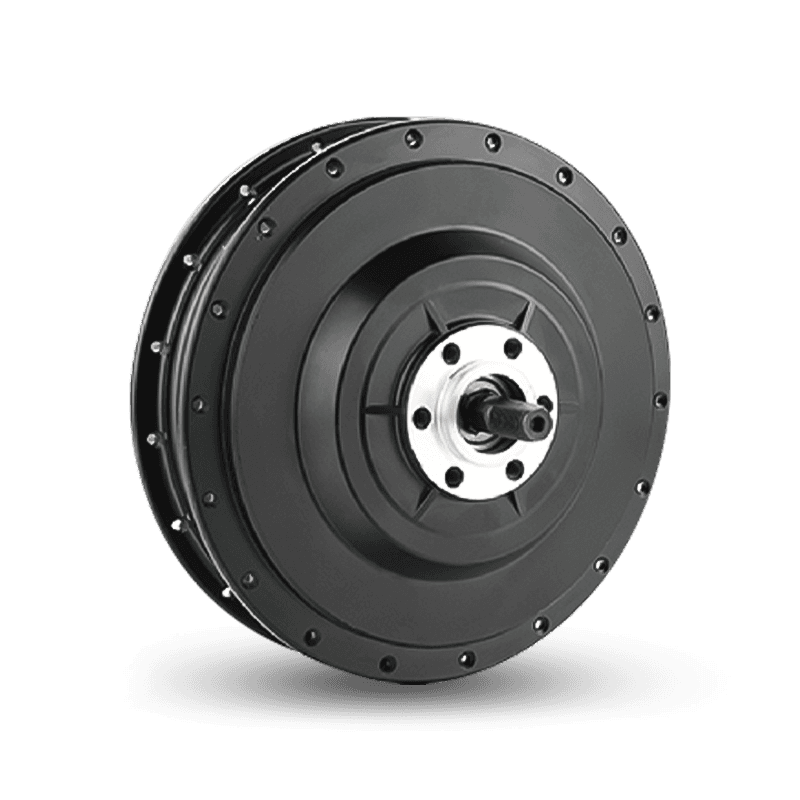 E-Type F500 Front Hub Motor
The E-Type F500 front hub motor is designed for E-Cargo and E-MTB bikes, offerin...
-
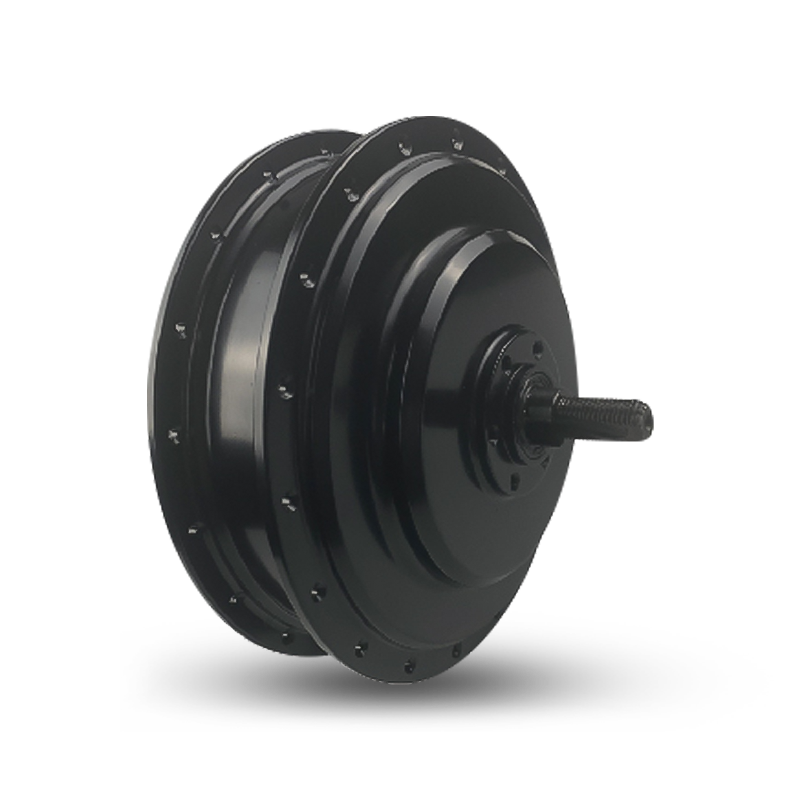 E-Type Pro RC750 Rear Hub Motor
The E-Type Pro RC750 Rear Hub Motor is designed for E-Cargo and E-MTB bikes, com...
-
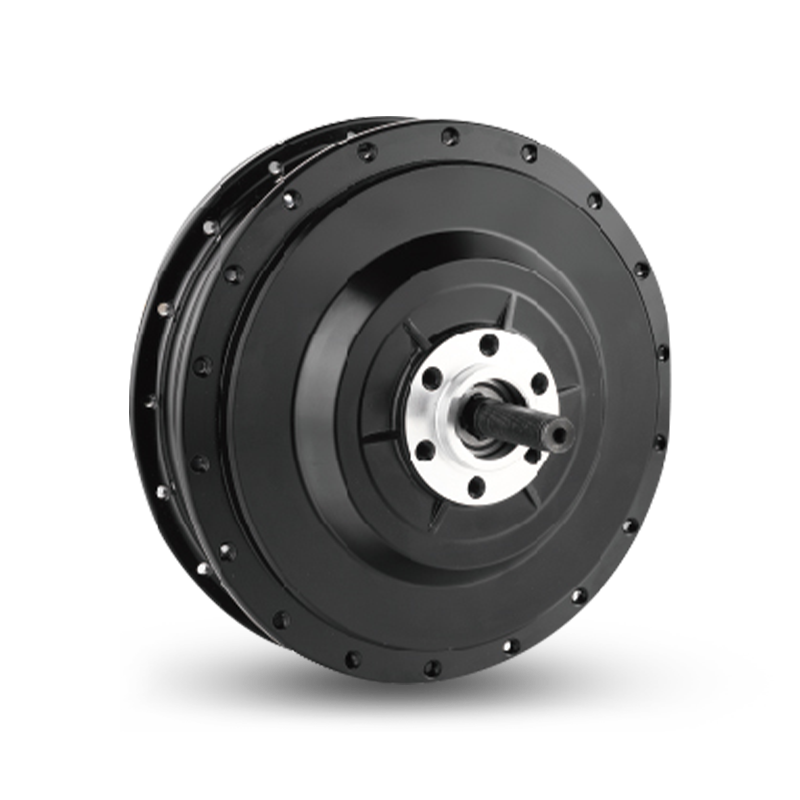 E-Type RF500 Rear Hub Motor
The E-Type RF500 Rear Hub Motor is designed for E-Cargo and E-MTB bikes, compati...
-
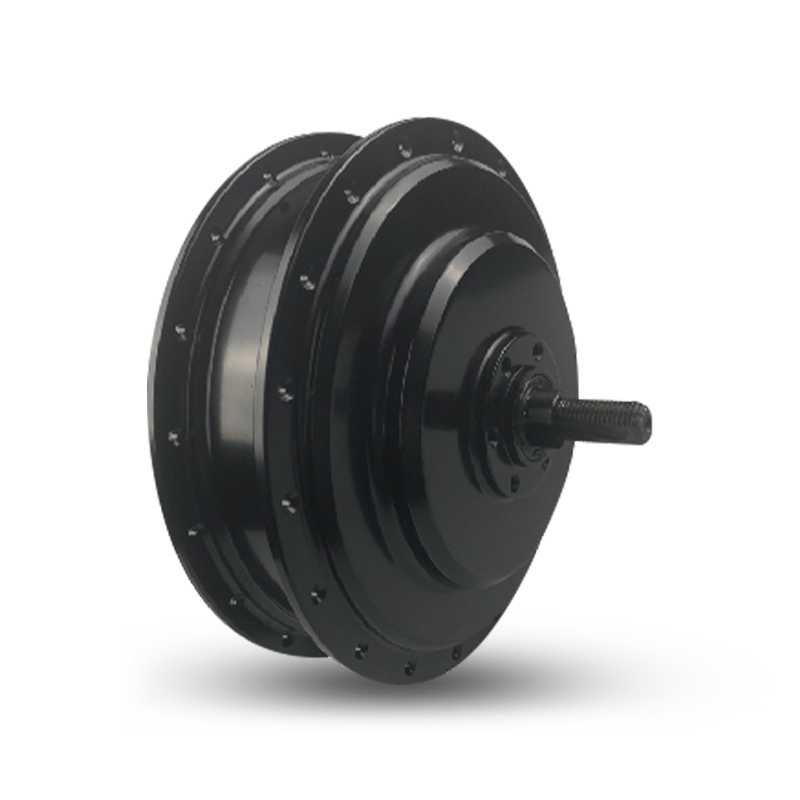 E-Type Pro RF750 Rear Hub Motor
The E-Type Pro RF750 Rear Hub Motor is designed for E-Cargo and E-MTB bikes, com...
-
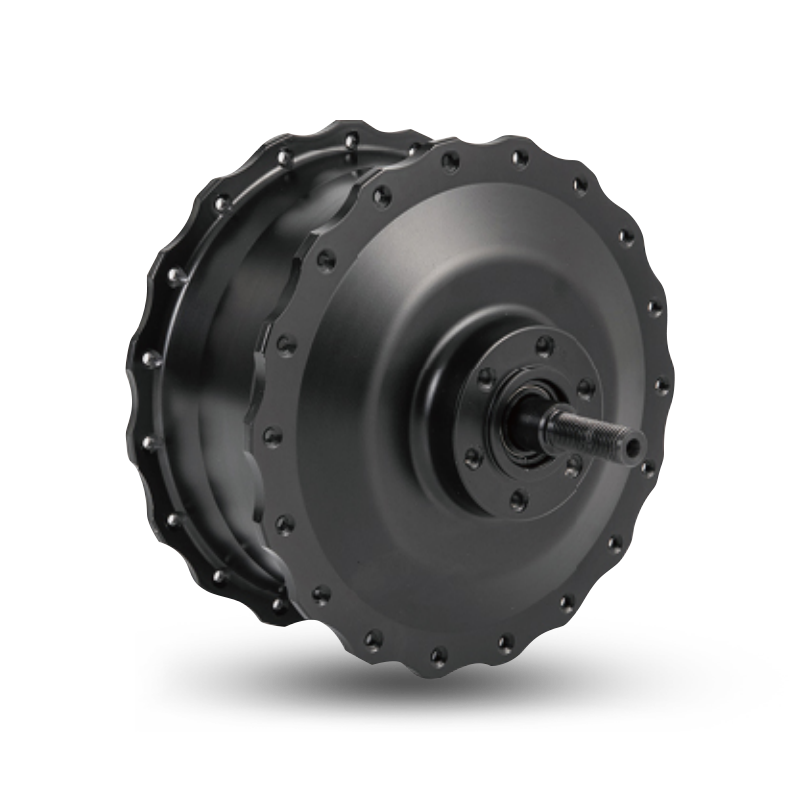 S-Type Pro F1500 Front Hub Motor
The S-Type Pro F1500 front hub motor, designed for E-Carao and E-Fat bikes, offe...
-
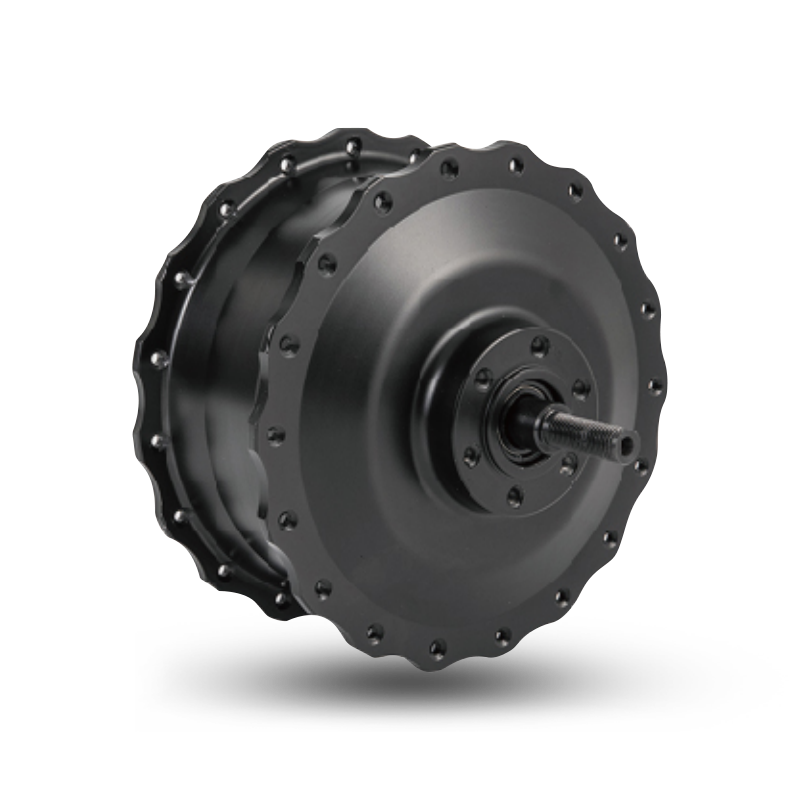 S-Type F750 Front Hub Motor
S-Type F750 is designed for E-Cargo and E-Fat. The rated power ranges from 500W ...
-
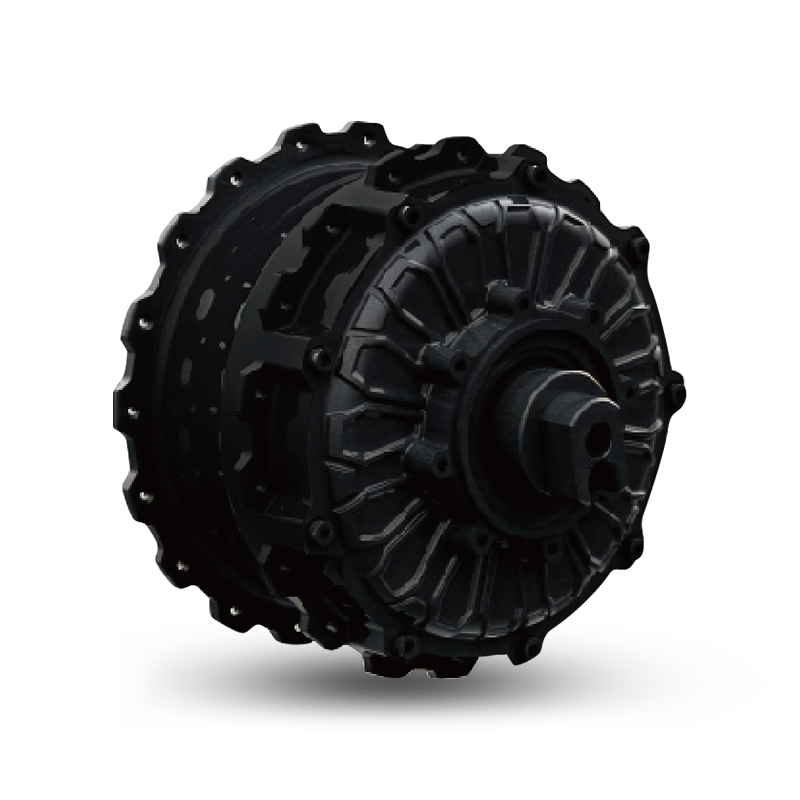 S-TYPE Max THRU AXLE Rear Hub Motor
The S-TYPE Max thru-axle motor is designed for E-Fat, Moped, and Cargo applicati...
-
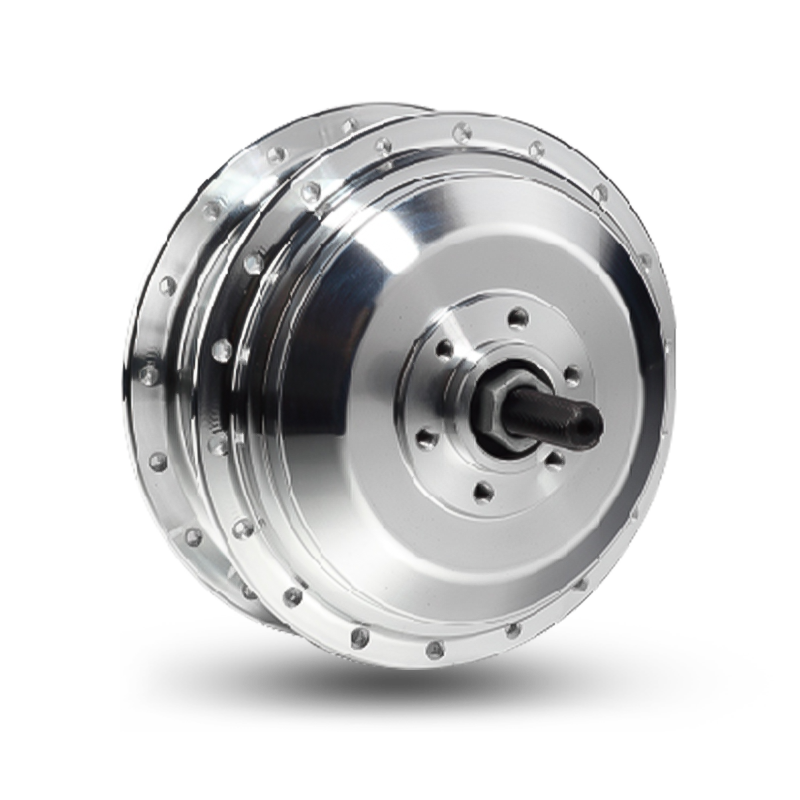 C-Type R350 Rear Hub Motor
The C-Type R350 Rear Hub Motor, designed for city e-bikes, offers a rated power ...
If you are interested in our products, please consult us
Contact Details
- Address:No. 3 Dingqiao Rd, Jiangshan Town, Yinzhou District, Ningbo, Zhejiang Province, China
- Phone: +86 13806662915
- Email: K.zhang@hengtai-cn.com
Products
Quick Link
News Center
Mobile terminal
